SR's previous post outlined our initial resistance to the patently disproportionate and
unreasoned government response to the COVID virus.With so many atrocities and misjudgments
littering the landscape with economic and social disaster, it is impractical to
encapsulate all objections and rebuttals to this governmental, political, and
media malfeasance in a single blog-post.Consequently, we will attempt to address this multiplicity of COVID
issues seriatim, highlighting those items that seem most critical as we descend
into what we hope is a temporary totalitarian nightmare.
The Heroes of World War II Weren't into Social Distancing
Dr. Fauci's Concession that COVID is like
Seasonal Flu.COVID skeptics like SR
have heretofore regarded the President's COVID adviser and resident expert Dr.
Anthony Fauci as rather alarmist and pessimistic, at least in comparison to the
President's sound emphasis that "the cure may be worse than the
disease."Now, however, Dr. Fauci
has apparently joined those of us who have stressed that the coronavirus is
similar in severity to the seasonal flu.In an article published in the respected New England Journal of Medicine on March 26, Dr. Fauci and two
reputable co-authors state as follows (emphasis added):
"[T]he currently reported
case fatality rate [for COVID-19] is approximately 2%. In another
article in the Journal, Guan et al. report mortality of 1.4% among 1099
patients with laboratory-confirmed
Covid-19; these patients had a wide spectrum of disease severity. If one assumes that the number of symptomatic or minimally symptomatic cases is several times as high as the number of reported cases, the case fatality rate may be considerably
less than 1%. This suggests that the overall clinical consequences of
Covid-19 may ultimately be more akin to those
of a severe seasonal influenza (which has a case fatality rate of
approximately 0.1%) or a pandemic
influenza (similar to those in 1957 and 1968) rather than a disease similar to
SARS or MERS, which have had case
fatality rates of 9 to 10% and 36%, respectively."
Fauci et al, New
England Journal of Medicine, March 26, 2020.
This
strengthens the view that the most extreme government measures employed against
COVID-19 are based upon hysteria rather than reason.Since the seasonal flu has never generated
anything resembling the coercive measures presently employed against COVID-19,
the government's wildly extreme reaction to the latter appears to be patently
disproportionate.
ZEROCOVID deaths in Japan on March 26, 2020 (despite rejecting extreme
measures).Japan was originally
identified as a prime candidate for very severe COVID-19 impact, owing in part
to the arrival of large numbers of infected passengers from the heavily
infected cruise ship, Diamond Princess.Notwithstanding this concern, Japan has not
heretofore resorted to the type of extreme coercive restraints on freedom that
have been followed in the U.S. and elsewhere (Japan did close its schools, but
is preparing to re-open them now).Despite its more temperate approach to quarantine and social distancing
mandates, Japan has experienced only a modest number of COVID cases and, in several
recent days, apparently zero deaths.According to the most recently posted data, Japan has experienced 1,693
total COVID cases, and 52 total deaths (compared to, e.g., about 17,000 cases
and 1028 deaths in the smaller-populated UK).Japan has managed this relatively successful containment even though it
is among the most densely populated nations in the world, and population density
is a primary factor for COVID contagion and mortality.Japan's experience indicates that the harsh
police state measures adapted in many U.S. states and cities are not necessary
for a reasonable COVID containment policy.
Cuomo and the Fraudulent Death Card.The COVID-Control extremists flatly reject
the application of cost-benefit analysis to the coercive, totalitarian measures
they impose (like closing schools and businesses and imposing obscene "shelter
in place" dictates) to purportedly control the spread of the
coronavirus.They are fully prepared to
ruin the nation's economy and quality of life if the ruination will prevent the
death of a single 80-year-old dotard from COVID-19 (even though he is apt to
die from something else next year).Lest
any reader consider this insensitive, SR is himself 75-years old, and fully
prepared to waive any claim to the government's solicitous
"protection."
New
York's obnoxious hereditary governor, Andrew Cuomo, expressed that irrational viewpoint
as follows in his brainless dismissal of any economic objections to oppressive
COVID coercion (from Reason, March
24, 2020):
"We're
not going to put a dollar figure on human life," said Cuomo (D), who last
Friday announced that "we're all in quarantine now" while ordering
all "nonessential" businesses to close. The goal, he explained, is to
"save lives, period, whatever it costs."In other words, Cuomo declares that
cost/benefit analysis is inapplicable to the adoption of any policy that
purports to minimize loss of life.
Continuing
his maudlin, melodramatic demagogy, Cuomo intoned:"My mother is not expendable, and your
mother is not expendable, and our brothers and sisters are not
expendable," Cuomo said when asked about "conservatives" who
have noted the heavy burdens imposed by sweeping restrictions on movement,
business operations, and work. "And we're not going to accept a premise
that human life is disposable."
With
rhetorical violins droning in the background, Cuomo portrayed rational cost
considerations in the following melodramatic vein:"We'll just sacrifice old people;
they're old people anyway. And the old get left behind….We're going to move on,
and if you can't keep up, well, you just fall by the wayside of life." He
described the consideration of the economic and social costs of extreme COVID
containment measures as "some
modern, Darwinian theory of natural selection."
Cuomo
is, plainly put, a mawkish, melodramatic jackass.We are lucky he was nowhere near the controls
when Roosevelt, Truman, and Eisenhower made the decisions which won World War
II, but at the known cost of untold legions of lives.Cuomo would have cancelled D-Day, in order to
"save lives, period, whatever it costs."
As one
of the "old people" who Cuomo purported to protect, my response to
him is:"Shove it, you irrational jackass,
and speak for yourself.Elderly people
with any brains and any guts do not
expect the younger generation to forfeit their claim to economic, social,
educational, and recreational opportunities merely to reduce our risk of
catching, and possibly succumbing to, the COVID virus."
There
are many times when some unspecified loss of life, or more accurately the risk
of such, is an inescapable cost of achieving the greater good, and this is one
of them.In the long run, millions of
lives will be ruined and even lost due to the obvious adverse consequences of
COVID coercion and quarantine.Further,
millions of youngsters have now forfeited the most momentous experiences of
their young lives due to the shortsighted stupidity of their elders in cancelling
the concluding months of an academic year – high school or college.
The
shutdown of businesses, commerce, travel, athletics, and ordinary economic
activity in the name of COVID Containment has already reduced to ruin an
economy that was booming on all fronts and obliterated the investments of
millions of ordinary Americans.Equally,
the shutting of schools and the attendant confinement of millions of healthy,
energetic youngsters to their homes is a social, recreational, educational, and
morale disaster of immeasurable dimensions.
Already,
literally millions of American youngsters have been deprived of that once in a lifetime opportunity to compete
as a senior in the basketball, lacrosse, track, swimming, or baseball
championships or playoffs for which they have spent years in preparation. They
will never recover this golden opportunity of their youth.And all because of the government's, the
media's, and the politicians' hysterical overreaction to a so-called virus
epidemic that, with each day, resembles ever more closely the seasonal flu that
is noticed by no one but the vaccination makers.
The Media and the Left Root for the Virus
and Resist a Cure.The media and
political left's furious resistance to the prospect of a readily available cure
for COVID-19 removes any doubt that they view this crisis as their supreme
opportunity to defeat President Trump and seize power in a leftist coup.
The
President has properly called attention to the prospect that chloroquine, or
hydroxychloroquine, may prove an effective cure to COVID-19.Since the President's duly qualified
statements, physicians and scientists in
China, Norway, Australia, France, Italy and elsewhere have confirmed tests and
treatments demonstrating the efficacy of chloroquine (especially in combination
with the well-known anti-cold Z-pac). With each day, the evidence that chloroquine is a good cure for COVID-19
becomes more persuasive.And the media
and political left's adamant and steadfast rejection of this stunningly
positive development conclusively confirms what SR and others have recognized
all along – the political left, the democrats, and their media allies
resolutely reject the prospect that the COVID crisis will be reduced, contained,
or resolvedbefore the presidential
election in November. The media and political left are actively rooting against the success of the chloroquine cure because they want the COVID crisis to persist, undermine the economy, and assure the defeat of President Trump next November. On this issue in particular, they have conclusively proven themselves to be the enemies of the people.
SR has heretofore refrained from posting on the
ubiquitous coronavirus or COVID-19 (hereafter CV19) crisis, and the utterly
unprecedented police state excesses imposed in its name.Our reticence was not rooted in lack of
interest or ideas on the subject, but rather on the reverse:The moment one appalling idiocy of the CV19
gestapo drove us to the keyboard in furious outrage, it would immediately be
superseded by a still more incredible totalitarian atrocity that rendered the
previous topic of subordinate urgency.
So
much COVID Lunacy, and so little time.
Assembly for Declaration of Independence: Illegal Gathering under COVID Rules
For
example, yesterday's news was that the crass and clueless Governor of Virginia had
extended the temporary closure of the State's public schools to at least a complete closure for the entire academic year. He imposed this ruthless totalitarian dictat even though there was not the least justification for such
a premature announcement at this time, other than to engage in the crude one-upsmanship of COVID extremism that the nation's governors are currently playing.
The reported 14 CV19-caused deaths in Virginia barely approaches the annual toll of the ordinary seasonal flu (or one month's murders in Baltimore), yet the notion of closing the schools based on
the seasonal flu would surely have been met with unanimous and well-deserved popular derision.Yet relegating Virginia's youngsters
to long months of educational, recreational, athletic, and social deprivation
in order to reduce the potential CVD risks for aged retirees (like me) – who are
already "playing with house money" anyway -- is accepted by today's feckless sheeple without
a murmur of dissent.
The concept of
cost-benefit analysisis apparently
beyond the ken of today's nanny-state tyrants, let alone their cowering
constituents. The crude COVID-based closure of the schools now sets the precedent for similar draconian measures in the future, justified by similar threats, like the recurring seasonal flu itself. When it is pointed out next year that the seasonal flu is apt to cause illness and deaths comparable to this years corona virus, how will the government justify avoiding the kind of extreme measures it has adopted against COVID-19?
But
today we learned of a bizarre new expansion of the COVID Police State that not even George
Orwell, in his wildest and darkest imaginings, would have contemplated.The Mayor of Chicago (one Lori Lightfoot) -- who lacks the cognitive powers to manage a neighborhood garage sale let alone
the welfare of the nation's third largest city -- has darkly declared that
lengthy walks, runs, or bike rides are now criminal acts under the COVID
Regime, and perpetrators are subject to citations, fines, and even arrest by
the Stassi that once passed for the Chicago Police.Since this dangerous mayor's crude declarations do not require embellishment to portray their grotesque excess, let them speak for
themselves (foxnews.com, March 26, 2020; emphasis added):
“Be
smart,” Lightfoot said Wednesday, according toCBS Chicago. “Not only will our police be deployed to shut them down if you are not abiding by these
orders, we will be forced to shut down
the parks and lakefront.”
Lightfoot
went on to announce that spending long
periods of time outside or in playgrounds is not
allowed.
“You cannot go on long bike rides.
Playgrounds are shut down,” she said. “You must abide by the order. Outside is for a brief respite, not for 5Ks.”
She
added: “I can’t emphasize enough that we abide [by] the rules.”
"This
is an order that’s enforceable by law," she reportedly said. "We’re
going to give you an admonition. And if you don’t turn right away and head
home then you’re going to get a citation. And
if worse, yeah, we will take you into custody."
She
added: "I hope that it doesn’t come to that, I hope that I don’t have to
shut down the lake front,
shut down all the parks, but I will."
If
this police state madness does not drive the reader to furious resistance to
the COVID madness, it is hard to imagine what will.A crude, uncultured, power-mad mayor of a
dysfunctional American city dictates to American citizens that they may not take a
hike, run, or bike ride unless they restrict it to an approved brevity that is
not specified – in short, the police have full leeway to arrest any walker,
runner, or cyclist at their unfettered discretion.
Welcome to the totalitarian dystopia of COVID America. Where venturing outside your home is limited to the "brief respite" allowed by the government.
And
the same civil libertarians who howl in outrage at the slightest government interference
with the violent protests of Antifa anarchists are now grotesquely silent in the
face of the most comprehensive police state restraints on the rights of
ordinary citizens since the founding of the Republic.
Merely for starters, the widely adopted
and spreading state COVID-based prohibitions of gatherings in excess of ten
people blatantly and indisputably violate the Constitution's prohibition of any
infringement of "the right of the people peaceably to assemble, and to
petition the Government for a redress of grievances."U.S. Const., Amend I.
In COVID America, Washington, Jefferson, Franklin, and the rest could not legally have gathered in Philadelphia to declare independence.
This
is the opening salvo in Splashing Rocks' protest against the extreme Police State measures that have been adopted by
federal, state, and local governments in grotesque overreaction to the COVID-19
virus -- a passing disease that is little more than a variant of the seasonal flu in terms of its
threat to the public health.In order to
"get the ball rolling," SR will end this post here, but will
enumerate in subsequent posts the totalitarian atrocities and stupidities that have been
imposed – and, worse yet, docilely accepted by a cowed and emasculated
citizenry.
The summer of 1961 was arguably
the most riveting and exciting season in baseball history.
That was the year when the incomparable New York Yankee
outfield duo of Mickey Mantle and Roger Maris staged a season-long duel in
pursuit of baseball's most illustrious and sacrosanct record:Babe Ruth's legendary 60 home run standard,
set in 1927.
I well remember rushing to the newsstand each morning that
summer to get the daily paper and check the sports page to see whether Maris, Mantle,
or both had homered the day before.Needless to say, there were no sports websites in 1961, and during the
summers back then active teenage boys like me (I was 16 at the time) had little
time or inclination to find what little TV sports news there might have
been.So I bought more newspapers that summer
than I ever did in my life – just to keep track of Mantle and Maris.Millions of American youngsters (and adults) did likewise.It was a special and unique season.
As the season progressed, and the two Yankee superstars
drew nearer and nearer to Ruth's record, reports of their home run progress
even moved from the sports page to the front page in some papers.As they say about the Masters golf tournament
today, it was "a season like no other."Even inveterate Yankee-haters followed the
daily heroics of the M&M Boys as they pursued the Immortal Babe.
Maris and Mantle: The Home Run Heroes of 1961
But there was also something of a dark element to the
Great Race for Ruth's record.For
unfathomable reasons, much of the sports media, and many fans as well, somehow
resented Roger Maris's role in this heroic home run derby.He was a relative newcomer to the Yankees (he had only joined them from Kansas City A's in 1960) and was viewed by many Yank fans as something
of an interloper.Mickey Mantle, on the
other hand, was already a well-established and well-beloved pin-stripe icon, with an appealing,
"aw shucks" personality.Mantle was the decided favorite of
most fans and reporters to break Ruth's record – if anyone did, that is.
Maris, on the other hand, was a painfully shy and quiet North
Dakotan who went about his baseball business with dedication and determination,
but little charm or charisma.In today's
media environment, he would be the star who somehow never gets the
endorsements.He had won the American
League MVP award just the year before (he won it again in 1961), but that somehow
seemed to be quickly forgotten.If any
star ever needed a shrewd PR agent, it was Roger Maris.But he was not the type to care about such
frivolity.
In 1961, the MLB season had been expanded from 154 games
(as it had been in Ruth's era) to 162.Consequently, baseball traditionalists and other crank sportswriters objected that if Ruth's record were not broken before the 155th
game of the season, it would be somehow illegitimate.Indeed, many traditionalists resented both
Mantle's and Maris's challenge to Ruth's record no matter how it was done.
Of course, the advantage of the slightly longer season was
probably offset by the more daunting challenge of modern pitching, especially
the factor of facing well-rested relievers, rather than arm-tired starters, in
the late innings of a game.Another
challenge to the modern sluggers was the added visual difficulty of hitting in night
games.But taking everything into
account, it is fair to say that neither Ruth's era nor Maris and Mantle's
enjoyed a decided advantage.In short,
the challenge to Ruth's great record in 1961 was a fair one (unlike the later steroid-enhanced home-run records of Mark McGwire and Barry Bonds).
As the season drew to a close, Maris gradually drew away
from Mantle in the home run race.Mantle's
pursuit of the record had been handicapped by a late season hip infection,
leaving Maris effectively in sole pursuit of the Babe (Mantle ended up with a
still remarkable 54 homers).
As Maris came closer and closer to the record with each
pressure-packed homer – 55, then 56, then 57, and so on -- the relentless daily
focus on his progress expanded from sports reporters to the general media.Reporters continually surrounded him,
demanding interviews.The daily stress
became so intense that Maris reportedly started to shed hair in clumps – which the
closely crewcut North Dakotan could ill afford.
Notwithstanding the pressure, Maris continued to pile up
the homers and the RBI's (he led the American League in both categories that year) and led
the Yankees to another AL Championship and subsequent World Series
victory.Even aside from this home run
record, it was an extraordinary season by any standard.
Even the President shared in the season's excitement: Maris signing a baseball for JFK at the White House.
On the last day of the season, October 1, 1961, under
unimaginable pressure and hostile scrutiny, Maris cracked his 61st
homer of the season -- a trademark rocket to the right field stands against the
Red Sox at Yankee Stadium.He had broken
baseball's most illustrious and revered record – and many embittered die-hard
reporters and myopic bystanders would never forgive him for his fabulous achievement.
But millions of kids like me (and grown up kids as well)
broke out into euphoric cheers as we listened to the announcer's call of No. 61
on our scratchy radios.Against all odds
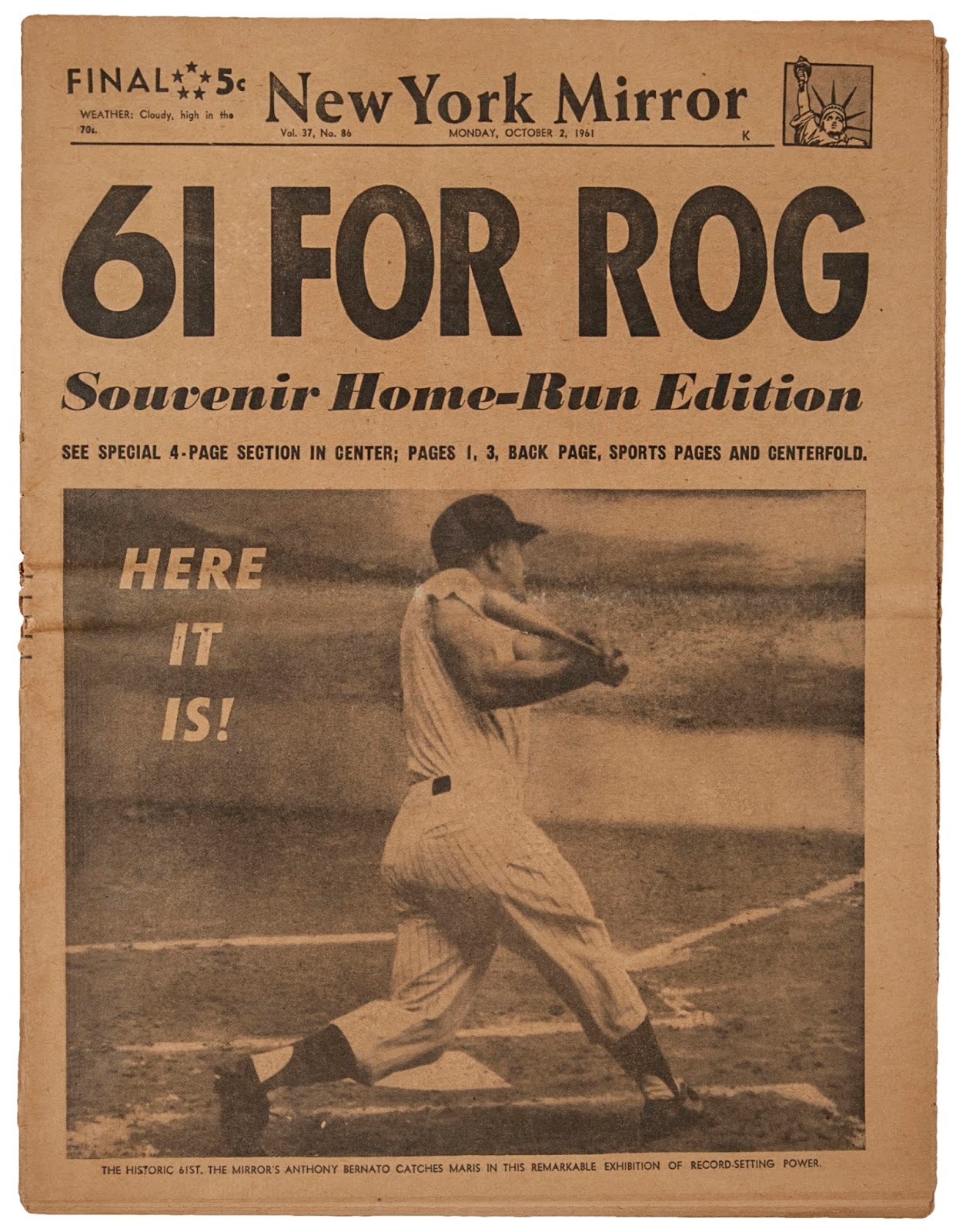
and opposition, Roger Maris had broken baseball's most illustrious record.It was a truly iconic moment in American
sports history, as captured on the front page of the New York Mirror's Souvenir "Home-Run Edition" (reproduced below).
How many Hall-of-Famers made a moment like this?
Despite the media naysayers, Maris was duly recognized in
1961 not only for his immortal record but for an extraordinary overall season
by any standard.He was awarded his
second consecutive American League MVP award and, beyond that, he was honored
with the Hickock Belt as the top professional athlete of the year.For that one great season, no one towered
over the American sports scene like Roger Maris.
The remainder of Maris's relatively short career was
somewhat anti-climactic, at least for the great slugger who had broken
baseball's greatest record. Nonetheless, he earned
World Series rings with the Yankees in 1961 and 1962, and again with the St.
Louis Cardinals in 1967.His star
performance for the Cards in their '67 Series victory (where he hit .385 and
had 7 RBI's) is rarely remembered, mainly because it was so starkly
overshadowed by his exploits as a Yankee Slugger.
Despite what could fairly be considered the greatest
single-season exploit in baseball history – achieved without the aid of artificial
stimulants and in the face of relentless
media hostility – Roger Maris remains excluded from MLB's Hall of Fame in
Cooperstown.This is a gross travesty,
and should be rectified by the HOF's Era Committee by proposing Maris's
well-deserved, if belated, admission.
The only plausible justification for Roger Maris's continued
exclusion from the HOF is the relative brevity of his career and, particularly,
his career as a top-flight star.But
that lame objection is forcefully overwhelmed not only by the singular and
historical nature of his remarkable 1961 season, but also by the extremely
great overall achievements of his peak years:Two MVP awards; three World Series Championship Rings; seven times
selected for the All-Star game; two-time AL RBI leader; and Gold Glove award
for 1960.Roger Maris, simply speaking,
was a great all-around player – and a winner to boot.
Moreover, the singularity of Roger Maris's home run record in 1961 is that it still stands today as the
American League home run record.Think of that.Babe Ruth's
immortal record had stood for an impressive 34 years when Maris broke it; yet
Maris's AL record still stands today, after 59 years!
Career longevity and career statistical landmarks (like
400 homers, 2,500 hits, or a lifetime .300 batting average) are surely
legitimate criteria for the Hall of Fame, but they are not the sine qua non.An iconic, illustrious feat such as Maris's
home run record, coupled with the genuine greatness of his peak seasons and his Three-Ring record as an indisputable winner, more
than offset the fact that this great player's career was only about 11 years
long.
The continued exclusion of Roger Maris from the Hall of
Fame is an inexcusable embarrassment to that otherwise admirable
institution.It is based on myopic,
unreasonable, and biased mindsets that have long since outlived any justification.The saturnine North Dakotan, who generated
what was probably the most riveting and fascinating season in baseball history,
should be admitted to Cooperstown at the next opportunity.
A mob of self-indulgent, selfie-taking Han millennials have traumatized the heretofore superior city of Hong Kong (known as the "SAR", or Special Administrative Region) with some two months of non-stop rioting and wreckage. Almost instantly, clueless members of both U.S. parties in Congress finally found a cause they could join hands on: glorifying and supporting these marauding Hong Kong hordes as though they were revolutionary heroes. Naturally, it is a misguided, ill-informed cause. Whether out of sheer ignorance or a diffuse animosity towards China, the West's political and media elites have reflexively embraced Hong Kong's rioters as though they were the heroic, revolutionary waifs of Les Miserables. Indeed, the Hong Kong herd has even gone so far as to sing -- laughably out of key -- that show's popular anthem, Can You Hear the People Sing, as though they were kindred spirits with Eponene and Marius. As though.
Eponene was not among the Hong Kong millennial heroes Alas, the Hong Kong rioters' Western cheering section has overlooked or ignored a critical aspect of the now two-month long uprising -- i.e., it has all the features of an anarchist revolution. Which is especially odd, since it takes place in one of the most thriving, prosperous, and attractive cities in the world. When an organized force engages in attacks on a government's law enforcement personnel and their headquarters; smashes their way into the government's legislative headquarters to vandalize it; shuts down a city's subway and traffic systems, thus preventing the citizenry from getting to work or engaging in ordinary commercial activities; occupies the city's international airport, forcing the cancellation of flights for extended periods of time and subverting the city's economy; and seizes and beats journalists and other citizens on mere suspicion of surveillance activity; then that mobilized force is engaged in a form of revolution. What color it takes is anyone's guess. If the Hong Kong marauders acknowledged their revolutionary status and accepted the consequences, it would be one thing. On the contrary, however, they expect to be treated like a harmless band of frolicking youth, even while they engage in violent and grossly disruptive insurgency. The most famous Chinese revolutionary of them all, Mao Zedong himself, aptly explained: "A revolution is not a dinner party." But Chairman Mao's admonition is entirely lost on Hong Kong's generation of snowflake revolutionaries, who would have dropped out of the Long March even before it crossed the Hunan border. Thus, the Hong Kong insurgents whine and squeal like wounded sheep when the beleaguered police have the temerity to meet their violent operations with even minimal force. After a single demonstrator suffered a "severe eye injury" when the police fired a beanbag projectile -- quelle horreur! -- the insurgents wailed as though PLA tanks and mortars had opened indiscriminate fire on thousands. Apparently, the rioters and their Western cheerleaders insist that not even minimal means of force can be used by police in responding to marauding mobs occupying the city's airport and lifeline to the world. What do they expect, after all, canapes and cocktails? As this is written, there are some signs that the mass protest is losing momentum. More and more ordinary Hong Kong citizens are insisting that "enough is enough." Whether the protests will whither away any time soon, however, remains to be seen. Although protest leaders have offered a tepid apology for the disastrous consequences of the airport seizure, they continue to insist that the City must accede to their primary demands, including: the removal of Hong Kong Chief Executive Carrie Lam; the release and exoneration of all protesters arrested for criminal offenses; an investigation of the police response to the uprising (but not the uprising itself!); and a repudiation of the factual declarations that the demonstrators engaged in "riots." Inasmuch as the Hong Kong government (not to mention Beijing) will certainly continue to reject these unrealistic demands, continued demonstrations can be expected to plague Hong Kong. The key question is whether the insurgents now recognize that they must tone down their demonstrations to a level that is tolerable to both the SAR and Beijing, not to mention ordinary Hong Kong citizens. Heretofore, Xi Jinping has deemed it prudent to withhold direct intervention by the PLA or other mainland forces, in recognition of the howls of outrage that would issue from the U.S., UK, and other Western governments and media if such action occurs. Nonetheless, it is doubtful that Xi's patience is inexhaustible. The severe chaos and lawlessness transpiring in Hong Kong -- which is after all part of China -- do not reflect well on Xi's image as a forceful Helmsman (and successor to Mao) in Beijing. There might well be hard-liners on the Standing Committee of the Politburo, or in the PLA, who are looking over Xi's shoulder with repressed frustration. Thus, continued extreme provocation by the insurgents in Hong Kong might yet force Xi's hand towards intervention as a matter of political self-preservation. Western governments, and U.S. congressmen, seemingly bent on provoking China with ill-considered declarations of support for continued insurgency, would do well to consider the potentially disastrous consequences of their feckless grandstanding. Before the recent disruptions, Hong Kong has enjoyed the reputation of one of the most prosperous, efficient, and advanced cities in the world. It ranks seventh in the world, for example, in Human Development Index (HDI), compared to No. 13 for the U.S. Its economy has been ranked as the most free and competitive in the world. It ranks at or near the top in such worldwide statistical indices as STEM scores, IQ averages, public safety, and life expectancy. This is the "oppressive" environment that the heroic Hong Kong militants are recklessly subverting with their prolonged campaign of disruption and defiance. Meanwhile, posturing U.S. politicians encourage the demonstrators in expanding their objectives from the reasonable goal of spiking the extradition legislation (which they have accomplished) to the wholesale reformation of the Hong Kong government into a Western-style democracy. However desirable that might be in theory, it is simply unfeasible under current realities. Indeed, pushing for such unrealistic demands may result in less, rather than more, freedom for the people of Hong Kong. Hong Kong is part of China as a matter of national sovereignty. China, while no longer a genuinely communist state, retains a totalitarian political system even while it embraces a mixed economic system with a heavy dose of capitalism. Yet China has heretofore tolerated a degree of personal, economic, and cultural freedom in Hong Kong that exceeds not only that allowed in Mainland China but, indeed, in most countries in the world. The excesses of the Hong Kong millennial mobs run the risk of undermining, rather than expanding, Hong Kong's overall prosperity and personal (if not political) freedoms. Addendum: A report just published by Reuters demonstrates by its own terms that the establishment Western media is publishing fake news to create the mythology that the Hong Kong marauders have the overwhelming backing of HK citizens. The report is headlined: "Hong Kongers rally against government under stormy skies." [emphasis added] But if one reads to the end, the story itself confirms instead that a far larger crowd (either 476,000 (claimed) or 108,000 (police est.) gathered to show support for the SAR government and the police than gathered to support the millennials continuing protest against the government (either 22,000 (claimed) or 8,300 (police est.). This is merely one of countless stories demonstrating that the mainstream western media are skewing and twisting this story to portray the insurgent mobs as the virtuous voice of the Hong Kong people overall, while portraying the admirably restrained police response as though it were the Czar's dragoons crushing the innocent starving masses with sabres in a scene from Dr. Zhivago. It is an open question whether the PRC-controlled outlets like People's Daily and Xinhua might actually be providing more accurate coverage on this story than the Western media.
SR
has devoted many posts to documenting the undervalued legacy of the Carpenters,
the sibling musical duo (Karen and Richard) who were the leading American pop
recording artists of the 1970's -- and, during the period of 1973-75, probably the
most successful pop/rock recording artists in the world. Apart from the fact that the Carpenters' story
is simply a significant piece of 20th Century cultural history, the derogatory
treatment of their music and legacy by elements of America's cultural
cognoscenti (e.g., the group's perverse exclusion from the Rock
and Roll Hall of Fame) has motivated SR to refute the false assumptions and biases behind that mistreatment.
An ironic aspect of this story is
the glaring contrast between the disparaging treatment of the Carpenters by critics
and hipsters in the U.S., even while the duo and their music have
enjoyed sustained popularity and great stature on the global level.
The Carpenters ' legacy remains
especially strong in Japan and the United Kingdom (the second and third largest
music markets in the world), where their albums have enjoyed strong sales well
into the 21st century and where a remarkably large number of
television documentaries (on both BBC and NHK) have been devoted to Richard and
Karen's musical history, especially the latter.As previously documented here, the Carpenters' enduring popularity is
also particularly strong in the countries of East Asia, most notably the
Philippines, Vietnam, Hong Kong, Thailand, Singapore, and, as we elaborate
below, the People's Republic of China (PRC).
Further evidence of the Carpenters'
sustained global impact is found in albums devoted to their music by
contemporary artists from all points of the globe.Dami Im, the Korean-born Australian sensation
of the 2016 Eurovision song contest, recorded an album aptly entitled
"Classic Carpenters," which reached No. 3 on the Aussie charts and
sold strongly in South Korea as well.In
Brazil, popular songstress Isabella Taviani released a tribute album called
"Carpenters Avenue" in 2016.And in 2009, a cohort of top Japanese pop/rock artists recorded yet another
Carpenters' tribute album called "Yesterday Once More – Tribute to the
Carpenters."
Yet the most extraordinary and
significant example of the Carpenters' international impact is found in, of all
places, the People's Republic of China.
Deng opened the airwaves and Karen's voice came floating into China
SR has previously explored this
subject.It initially drew our attention
as something of a piquant cultural anomaly.Who would imagine, after all, that the pop tunes produced by a
pair of unsophisticated Southern California suburban siblings in the 1970's would
come to captivate the masses in a country and a culture literally world's away
from Downey, California?Yet that is
exactly what occurred, in the midst of China's emergence from the cultural dark
ages of the Maoist Era and its soul-crushing Great Proletarian Cultural
Revolution.
Unfortunately, the paucity of hard data on internal
developments in China during the immediate post-Maoist era -- let alone data on
an esoteric topic like the introduction of Western popular music -- has
made it difficult to document the impact of the Carpenters music in China with
much specificity.Because
SR believes that impact has genuine historical and cultural significance – after
all, reliable Chinese sources have gone so far as to assert that "Karen Carpenter was the beginning of
the [cultural] opening of China" – this post attempts to document
Karen and the Carpenters' musical conquest of the world's largest nation with
the best available information (mostly culled from Internet postings).
This extensive information
establishes that the Carpenters, and especially their global hit song,
"Yesterday Once More," were the most popular and influential sources
of Western music in China for a period of at least 25 years – i.e., roughly 1985 to 2010.Outlined below is a chronological
documentation of the background and progression of this remarkable
cross-cultural phenomenon, and its surprising effect on the world's largest nation.
Karen Carpenter sings "Yesterday Once More" at Tokyo's Budokan, 1974
1973 – Hits in Hong Kong
By 1973, the Carpenters were firmly
established as pop superstars, and their popularity had extended
internationally to such countries as the UK, Japan, and Australia.In that same year, the Carpenters achieved an
enormous breakthrough in several East Asian markets, notably Malaysia,
Singapore, and especially Hong Kong.As
documented in Billboard magazine's periodic
listing of international pop charts, no less than three Carpenters' singles
reached No. 1 on the Hong Kong hit parade in 1973:I Won't
Last a Day Without You (No. 1 for 6 weeks!); Sing; and Yesterday Once More.At that time, Hong Kong was still a British
Crown Colony and thus not part of Chinese sovereignty.Nonetheless, its population was
overwhelmingly Chinese.It is fair to
say that the Carpenters' early success in Hong Kong presaged their subsequent
popularity in Mainland China years later.
1976 – End of the Cultural
Revolution and Death of Mao
Starting around 1966, China had been
immersed in the political, social, and cultural madness of Mao Zedong's Great
Proletarian Cultural Revolution (GPCR).While hordes of fanatical Red Guards ran rampant brandishing Mao's
Little Red Book, much of the nation was forcibly preoccupied with abject
subservience to the demands of the Maoists as a matter of mere survival.The only forms of music or other
entertainment allowed were those which extolled Maoism and the GPCR, such as
the militant anthem, "The East is Red," or the "Communist
Internationale." Under the iron
hand of Mao's wife and PRC cultural dictator, Jiang Qing, China was purged of
all Western cultural influences, including even classical music.
By 1976, the GPCR had run its
course, and Jiang Qing and her leading GPCR cohorts (notoriously known as
"The Gang of Four") were themselves purged.The ban on Western classical music was
lifted, although it would be years (see below) before China's gates were opened
wider to accept various forms of contemporary and popular Western music.
1976 also saw the death of Chairman
Mao himself, which would clear the way for a more pragmatic and permissive group
of leaders to assume power in China.
1978-1982:The
Reforms of Deng Xiaoping.
Around 1978, the historical Chinese
pragmatist, Deng Xiaoping, began to assume de facto leadership of the PRC (he
never assumed the highest titular leadership posts, but preferred to lead from
the background).Under Deng's pragmatic
reform programs, the totalitarian control of all aspects of life imposed by Mao
was substantially reduced.In
particular, communist economic doctrine was jettisoned in favor of a system
that not only permitted, but encouraged, a considerable amount of capitalism,
free enterprise, and profit-seeking.Although Deng's reforms did not extend to the purely political realm
(i.e., China remained a strictly one-party state), they did abandon the
Maoist's harsh restrictions on the entry of Western culture, including popular
music.It is evident,
however, that most Western music probably entered China through unofficial, irregular
back-channels, rather than through orthodox commercial transactions.
1983:The Untimely Death of Karen Carpenter.
After a lengthy struggle with the
then little-known eating disorder, anorexia nervosa, Karen Carpenter died on
February 4, 1983.Among the many tragic
aspects of Karen's early death was that she never lived to realize the enormous
global impact of the beautiful music that she and her brother, Richard, had
given the world.
1984:Success
of YOM Album in Hong Kong and first infiltration
into Mainland China; UK/PRC Agreement for Reversion of Hong Kong
In October, 1984, A&M Records released a
commemorative 2-disc Carpenters album entitled "Yesterday Once More,"
after the hit single of that name that was also the lead-off song on the album. The album was an international success.As shown on Wikipedia's entry on the album, it
was certified Platinum in the U.S., Japan, the UK, and, curiously,
"China."The source listed for
the Platinum certification in China was BPI, the British Phonographic Industry.It is highly doubtful, however, that BPI
would be in any position to certify sales of the YOM album in China itself; in 1984, it is highly doubtful that there were
regular commercial sales of Western recordings in China at all, let alone any
systematic tracking or ranking of such sales.It is pretty clear, therefore, that BPI's reference to the Platinum
certification of YOM for "China" really referred to Hong Kong, which
was then still a British Colony.
Nonetheless, it is quite probable that the popularity of
the YOM album in Hong Kong led to its infiltration into Mainland China, which
was then lowering the barriers to such foreign cultural imports.This proposition is reinforced by the
appearance of reports (see below) that the Carpenters' music, and YOM in
particular, had achieved great popularity in Mainland China by the mid-1980's,
i.e., around 1985.
A related major event of 1984 was the Sino-UK Joint
Declaration, whereby the UK committed to the reversion of Hong Kong to Chinese
sovereignty by 1997.The inescapable
reality of Hong Kong's forthcoming reversion to China undoubtedly opened the
door to increased interchange of commerce, products, and culture (including
musical recordings) between Hong Kong and the PRC.
1985/Mid-1980's:Carpenters and YOM lead
Western songs gaining popularity in China.
An article published in the Shanghai Star in 2002, discussing the mid-1980's period when Western
music was just gaining increased entry into China, reported as follows:
"The first foreign voice that captivated
the Chinese audience was Karen Carpenter. College students recorded her songs from one
tape to another, spreading her voice further and further.A widely-used English language teaching
textbook even took one of her songs as a listening text."Pop
Rhythm Rolls On, Shanghai Star (Jan 3, 2002) [emphasis added].
In 1988, an article posted on the LAT web archive
stated:"[In China], John Denver
and Karen Carpenter are bigger stars than the Rolling Stones."P. Goldstein, China's Age of Innocence in Rock (Nov. 13, 1988).
An article published in 2004 in the Chinese Business
Newspaper Weekend Standard contained
an especially authoritative testimonial to the origins of the Carpenters'
(especially Karen's) popularity in China.The article opened with the following:
"If I were a Carpenter I'd be bigger
than the Beatles in China.Way bigger.
. . .When I'm on the mainland not a day
goes by that I don't hear some version of Yesterday
Once More, or as most Chinese seem to call it, 'Sha-la-la,' in reference to
the chorus."
The article's author was an American cynic who was
completely puzzled by the Carpenters' popularity, so he consulted a
knowledgeable Chinese-American musician and reporter named Kaiser Kuo, an
expert on (and participant in) the growth of modern Western music in
China.Mr. Kuo completely demolished the
author's anti-Carpenter assumptions, explaining as follows:
"[The Carpenters] dwarf the Beatles in
popularity.Part of it is simply that The Carpenters Greatest Hits was about
all there was back then. . . . That and some old John Denver that they could
legally distribute.
"Yesterday
Once More is the first tune on that compilation, and while Carpenters
connoisseurs might prefer Rainy Days and
Mondays or Superstar, that was
the tune that really stuck with people.
"That aside, people in China uniformly love Karen's deep, sultry voice.It stood out then and stands out now as
something totally unlike the vocal stylings of any Chinese singer.The very simple melodies are also
appealing.My very cool, very hip
friends who listen to metal, to hardcore hip-hop, to whatever, still profess a
love for the Carpenters and can't imagine that they're sort of a joke to most
Westerners."Every sha-la-la-la Still Grinds, Weekend Standard (Nov. 6-7, 2004)
[emphasis added].
A 2008 article by a UC Irvine professor named Jeffrey
Wesserstrom outlined his Top Five List of what he considered the "Weirdest
Rock Music Moments with Chinese Characteristics."No. 2 on this list was, "The Carpenters
hit it big in China in the mid-1980's," as to which he noted, "[T]heir
music seems to have had even greater staying power than [John] Denver's." (Author's Note: John Denver is generally recognized, along with the Carpenters, as the most popular Western recording artists in China during the introductory post-Maoist years.)
1998:Newsweek's Shanghai article; remarkable
testimony of Yu Lei.
In 1998, Newsweek
magazine published an article entitle The
Rebirth of Shanghai as part of its report on "The New
China."The article featured the
remarks of one Yu Lei, who was then a 29-year-old reporter for the Shanghai Star.Mr. Yu's recollections are worth recording at
some length:
"When he [Mr. Yu] was a kid, he recalls,
Western arts and media were still banned in China, so one of his teachers
recorded an American song off the shortwave radio.Huddling the students behind closed doors,
and warning them not to tell anyone, the teacher wrote the lyrics on the
blackboard and taught the class to sing along.It was dangerously exciting, the lure of forbidden fruit.But what struck Yu most was the sweetness of
the melody, the purity of the singer's voice.The singer was Karen Carpenter, who shortly became one of the first Western
performers sanctioned in China.Years
later, as the Filipino band at the Gap shinga-linga-lings into the Carpenters' Yesterday Once More, Yu can still hear
the sweet strains of revolution.Karen
Carpenter, he declares, "was the beginning of the opening of China."
Jan. 14, 1998:A
Chinese internet posting of this date lists YOM as the No. 1 all-time Western
song in China.Numerous other unofficial
internet postings by Chinese bloggers similarly list YOM as the No. 1 English
language song favored by the Chinese.E.g., Pa Mak Recommended: the most
classic of Ten English Language Songs (March 23, 2014); Top 10 English Songs favored by Chinese
(July 7, 2009).
2003:Karen
Carpenter "is insanely popular" in China.
An Internet blog posted in September 2003, "The Road
to China, Ch. 4, Moon Festival," included the following commentary on the
state of then contemporary music trends in China:
"[T]he airwaves here are filled with a
mix of classical and modern Chinese music, all of which, as a whole, is the
most beautiful music one can hear on any continent.About the only American artists that I
encounter consistently are the Back Street Boys, N Sync, and Karen Carpenter (who is insanely popular even now).[emphasis added].
2004: Chinese music-lovers "revere the Carpenters."
Novelist Donald Gallinger noted as follows in an October,
2004, journal entry, included in his article, Memoirs of China:The Chinese
and Karen Carpenter (Apr. 4, 2009):
"The Chinese people all know Western pop
music.But they particularly revere the
Carpenters and it is not unusual to hear 'Yesterday Once More' booming out of
the shopping mall sound systems.I
cannot tell you the number of times I've heard that song swirling around
restaurants and bars. . . . [I]t is also not unusual for Chinese youth to begin
singing along with the Carpenters."
2005:YOM is
Embedded in Everyday Chinese Cultural References
A report on the women's badminton competition in China's
10th National Games in the Oct. 8, 2005, edition of Xinhuanet (Kunshan, East China),
illustrates how YOM is so well known
in China that reporters assume that casual references to the song will be immediately
understood by Chinese readers.The
report included the following such references:"If Hunan wins over Guangdong, it could only remind people of Karen
Carpenter's famous song 'Yesterday Once More.' . . . The biggest hurdle
preventing Hunan singing 'Yesterday Once More' happily would be the question of
injuries on 'old' top players."
2007:The China Drive Survey; a Critical Cynic's
Astonishment
In 2007, the popular Chinese radio station China Drive conducted a survey asking
listeners to name the first foreign song they recall hearing in China.Well over 50% of the listeners responded that
the Carpenters' Yesterday Once More
was that song.China has a population of
about 1.4 billion people.If the China Drive survey was in any way
representative of the nation, the number of Chinese people who have heard and
recalled YOM is indeed enormous.
That same year, an anti-Carpenter cynicwho taught college classes in China ruefully
acknowledged the Carpenters' enormous popularity there, even while deploring
it.The
Country That Taste Forgot (Internet blog, March 30, 2007).The author reported that YOM, John Denver's Country
Roads, and the Eagles' Hotel
California were the most popular songs in China; that his students loved YOM; and that the Carpenters' music was
ubiquitous in the town where he taught.
2009:The
Carpenters are revered in Mainland China.
An American blogger in Beijing, A. E. Perkins, confirmed
the Carpenters' continued popularity and stature in China some 25 years after
their music's initial entry.A. E.
Perkins, China and the Carpenters, Beijing
Review (Oct. 15, 2009).As Perkins
wrote:
"If there is something about mainland China
which I never expected before, and absolutely amazes me now, it is the
connection its citizens have with the music of the Carpenters. . . .I encounter evidence almost every day that
mainland Chinese have a special place in their minds and hearts for Richard and
Karen Carpenter."
Noting that the Carpenters originally became the
top-selling musical act in the U.S. back in the 1970s, Perkins added:"That makes it all the more remarkable
that they are so revered in mainland China."
2010:Carpenters Tribute Band is Hottest Ticket in Beijing and Shanghai.
Laurie Briggs of the Karpenters tribute band that drew huge crowds in China So-called tribute bands, who give concerts attempting to
duplicate or approximate the sound and look of legendary rock bands of the
past, have enjoyed considerable success in the U.S., the UK, Canada, and
various countries in East Asia.There
have been quite a few Carpenters tribute bands in recent years, probably the
most prominent of which is a UK-based group styling themselves The
Karpenters.One internet blog reported
as follows on the enormous success of this group's Carpenters tribute shows in
Beijing, Hong Kong, and Shanghai, where they reportedly outdrew Whitney Houston.Tribute
Act are Big Stars in China (March 1, 2010):
"[I]t has taken just one gig to make the
Karpenters hot property with the Chinese public.Such is the clamor in the Far East for
tickets to see Laurie Briggs perform as her alter-ego Karen Carpenter, the
Pudsey-born singer is now out-selling Whitney Houston.
"Laurie, along with Jason Scott, aka
Richard Carpenter, and six other members of the act will sell out massive
venues in the country's major cities.They fly out in April for a ten-date televised tour which takes them to
Beijing and Shanghai.
"Their big break comes after they played
at the Hong Kong Convention Center in November to a capacity 5,500 audience – a
feat U.S. diva Whitney Houston could not get near.Laurie told the YEP:'We were told that Whitney struggled to sell
half as many tickets when she performed at the same venue. . . .It just goes to show how much the people over
there love the Carpenters that a tribute act can attract so much attention.
"The Carpenters have long been revered
by people of all ages in China and the Far East."
Another contemporaneous internet report confirmed the enormous
success of this same Carpenters tribute band and the Carpenters continuing
popularity in China (Gig of the Year,
Froog's Blog (May 12, 2010; emphasis in original):
"Long ago, I remarked upon this
country's strange obsession with Karen Carpenter.She was one of only a handful of Western
music stars to get any exposure in China in the 1970s, and is probably the one
most fondly revered to this day (it's a tossup between her and John
Denver).Hence, the May Day visit to
Beijing of English cover band The
Karpenters was the most anticipated
gig of the year (decade, millennium) for many local music fans, and the
tickets were therefore stratospherically expensive."
2013:YOM Still on Top.
An Internet posting of Feb. 19, 2013, by one Yansong Sun,
discussed the remarkable continued popularity in China of John Denver's
"Country Roads" and the Eagles' "Hotel California."He then clarified, however, that YOM (along with "Say You, Say
Me") was even more popular and remained one of the two "most popular
English songs in China."
2015:Carpenters and the Terracotta Warriors in Xi'An.
Author Charles Cottle provides a fitting conclusion for
this history with an article recording his 2015visit to Xi'An in Central China to see the famous Terracotta Warriors
statues (some 8,000 of them!).C.
Cottle, Karen Carpenter and the
Terracotta Warriors, Century Life (Internet blog, Aug. 8,
2015).He records his experience having
breakfast at his Xi'An hotel when the staff thoughtfully turned on some
background music they thought he would enjoy – none other than the Carpenters' YOM.Cottle recalled:
"On hearing Karen Carpenter sing these
lyrics, I sat transfixed.
"Several years have passed since I sat
atop that hotel listening to Karen Carpenter sing while I gazed over the city
of Xi'An.Yet the passage of time has
not erased the connection between her and the terracotta warriors.If I think of her, I think of them.In my mind they are forever linked.And whenever I see images of the cold-faced,
yet life-like, terracotta warriors, I am immediately reminded of the sweet,
sweet voice of Karen Carpenter."
***
There are many more similar reports and stories documenting the story of the Carpenters musical "conquest" of China, but the reader has probably seen enough. Although much of the evidence is informal and unofficial, the diversity and broad time-range of these testimonials confirm the fact: the Carpenters' music, particularly YOM, was the most popular and influential pop music in the world's largest nation during a period of roughly 25 years (1985-2010) -- i.e., the period when Western music gained a foothold in China in the wake of the repressive Maoist era.
Some may consider all this merely esoteric cultural trivia, of no great significance. Others, however, may agree with SR that the impact of the Carpenters' music in China was indeed quite significant for many reasons, including the following:
1. It brought an infusion of refreshing musical sunshine to millions of people who had lived under the stifling cloud of Maoist repression for some 50 years.
2. It made a notable contribution to the overall liberalizing influence of Western culture that helped nudge China in the direction of a more open and permissive society (outside the strictly political realm).
3. It supports the proposition that music which is tuneful, melodious, and harmonic, especially when sung by an especially beautiful voice, has greater universal appeal across national, linguistic, and cultural barriers than fad or esoteric "message" music (like rap, grunge, or acid rock), the appeal of which is often "lost in translation."
4. It reinforces the Carpenters' status as one of the most popular and influential musical groups of the 20th Century on the global or international level.